"Gordon Parks: How the Photographer Captured Black and White America"
by Carole Boston Weatherford
Illustrated by: Jamey Christoph
Accelerated Reading Level: 4.0
Teachers today work hard to encourage their students' dreams. But when Gordon was in school, his white teachers didn't have high expectations for him or many of his classmates. But Gordon's determination to make a difference was not to be denied -- no matter what teachers or society told him. With a used camera, Gordon taught himself photography. He went on to become the first black photographer for Life magazine and documented the civil rights movement. This inspiring tale would make a great companion book to use with "Dorothea's Eyes" by Barb Rosenstock which I wrote about earlier this summer (Sweet Summertime).
If you are fortunate enough to have devices for your students to take pictures with, a perfect learning extension for these books would be to challenge your students to take a picture about a social injustice they see in their community and then write about it. Who knows, maybe they will become the next famous photographer that helps change the world!
A place to help elementary teachers and children develop their love of reading and learning.
Showing posts with label determination. Show all posts
Saturday, September 3, 2016
Thursday, August 25, 2016
Mapping the Ocean Floors
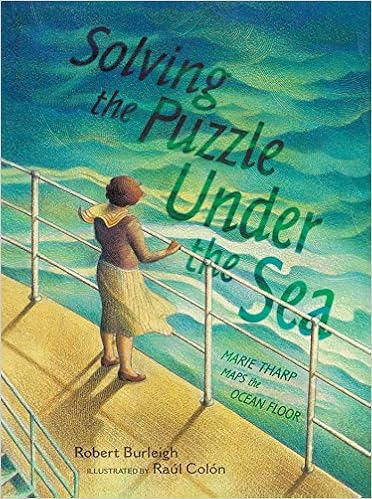
"Solving the Puzzle Under the Sea" by Robert Burleigh
Illustrated by Raul Colon
Accelerated Reading Level: 5.0
This beautifully illustrated story, told in first person, is of a trailblazing scientist and cartographer, Marie Tharp. As a child, Marie traveled with her father, a cartographer who specialized in helping farmers by mapping soil types in the central US. Because of that, she fell in love with maps and decided to be a cartographer too. While in school, she learned that little was known about oceans. This lead her to wonder what the oceans' floors were like. So in an era where women were not welcomed into many careers (1940's), Marie perseveres and becomes a scientist. She gets a job at the ocean lab of Columbia University in NY. Here she faces another challenge -- debunking superstitions, as it was considered bad luck to have a women on a ship. Stuck on land, she takes on any job they give her and works hard to prove herself.
I was particularly struck by the admission that sometimes she was bored at the menial requests and thought about quitting, but Marie never gave up or stopped searching for something that might lead to a new scientific discovery. This reminds me of children who don't see the value in doing repetitive tasks such as practicing a musical instrument, a sport, or reading. What might they learn if they persevere?
Eventually, Marie makes friends with Bruce Heezen, and together they start trying to figure out how deep the oceans are and what the topography is like on the floor of the ocean. Using a new technology, sound waves (called "sounding"), they set out to map the ocean floors. Marie discovers the mountains and valleys underwater, and later discovers an extra deep valley that divides the Atlantic into two parts. She is the first to draw a detailed map of the Atlantic Ocean. As a result of her work, Marie discovers proof of plate tectonics and continental drift.
Many grade levels do mapping units and a common task given to students is to make a map of a familiar place such as their classroom, their bedroom or their house. This is not any easy task for young elementary students as they struggle with scales. But what if you asked them to map something they can't see --- the insides of a hollow of a tree or the insides of beehive or a bird's nesting box? What might they discover? What would it lead them to wonder about next?
Illustrated by Raul Colon
Accelerated Reading Level: 5.0
This beautifully illustrated story, told in first person, is of a trailblazing scientist and cartographer, Marie Tharp. As a child, Marie traveled with her father, a cartographer who specialized in helping farmers by mapping soil types in the central US. Because of that, she fell in love with maps and decided to be a cartographer too. While in school, she learned that little was known about oceans. This lead her to wonder what the oceans' floors were like. So in an era where women were not welcomed into many careers (1940's), Marie perseveres and becomes a scientist. She gets a job at the ocean lab of Columbia University in NY. Here she faces another challenge -- debunking superstitions, as it was considered bad luck to have a women on a ship. Stuck on land, she takes on any job they give her and works hard to prove herself.
I was particularly struck by the admission that sometimes she was bored at the menial requests and thought about quitting, but Marie never gave up or stopped searching for something that might lead to a new scientific discovery. This reminds me of children who don't see the value in doing repetitive tasks such as practicing a musical instrument, a sport, or reading. What might they learn if they persevere?
Eventually, Marie makes friends with Bruce Heezen, and together they start trying to figure out how deep the oceans are and what the topography is like on the floor of the ocean. Using a new technology, sound waves (called "sounding"), they set out to map the ocean floors. Marie discovers the mountains and valleys underwater, and later discovers an extra deep valley that divides the Atlantic into two parts. She is the first to draw a detailed map of the Atlantic Ocean. As a result of her work, Marie discovers proof of plate tectonics and continental drift.
Many grade levels do mapping units and a common task given to students is to make a map of a familiar place such as their classroom, their bedroom or their house. This is not any easy task for young elementary students as they struggle with scales. But what if you asked them to map something they can't see --- the insides of a hollow of a tree or the insides of beehive or a bird's nesting box? What might they discover? What would it lead them to wonder about next?
Subscribe to:
Posts (Atom)