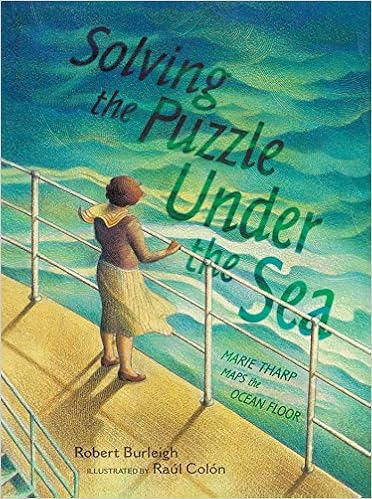
"Solving the Puzzle Under the Sea" by Robert Burleigh
Illustrated by Raul Colon
Accelerated Reading Level: 5.0
This beautifully illustrated story, told in first person, is of a trailblazing scientist and cartographer, Marie Tharp. As a child, Marie traveled with her father, a cartographer who specialized in helping farmers by mapping soil types in the central US. Because of that, she fell in love with maps and decided to be a cartographer too. While in school, she learned that little was known about oceans. This lead her to wonder what the oceans' floors were like. So in an era where women were not welcomed into many careers (1940's), Marie perseveres and becomes a scientist. She gets a job at the ocean lab of Columbia University in NY. Here she faces another challenge -- debunking superstitions, as it was considered bad luck to have a women on a ship. Stuck on land, she takes on any job they give her and works hard to prove herself.
I was particularly struck by the admission that sometimes she was bored at the menial requests and thought about quitting, but Marie never gave up or stopped searching for something that might lead to a new scientific discovery. This reminds me of children who don't see the value in doing repetitive tasks such as practicing a musical instrument, a sport, or reading. What might they learn if they persevere?
Eventually, Marie makes friends with Bruce Heezen, and together they start trying to figure out how deep the oceans are and what the topography is like on the floor of the ocean. Using a new technology, sound waves (called "sounding"), they set out to map the ocean floors. Marie discovers the mountains and valleys underwater, and later discovers an extra deep valley that divides the Atlantic into two parts. She is the first to draw a detailed map of the Atlantic Ocean. As a result of her work, Marie discovers proof of plate tectonics and continental drift.
Many grade levels do mapping units and a common task given to students is to make a map of a familiar place such as their classroom, their bedroom or their house. This is not any easy task for young elementary students as they struggle with scales. But what if you asked them to map something they can't see --- the insides of a hollow of a tree or the insides of beehive or a bird's nesting box? What might they discover? What would it lead them to wonder about next?
A place to help elementary teachers and children develop their love of reading and learning.
Showing posts with label perseverance. Show all posts
Thursday, August 25, 2016
Sunday, August 7, 2016
Sweet, Sweet Summertime
Nothing speeds by as quickly as summer, for both students and teachers. It is a time of relaxation, regeneration and exploration. For me, one of the true pleasures of summer is exploring new children's literature and thinking about how to incorporate them into my teaching in the coming year or how to partner future students with the perfect book to inspire them. It is my goal to use this blog to share some great books and their potential use in the classroom. I hope that some of the books shared here become your favorites in the future!
Many times, adults tend to only share cute, colorful, rhyming pictures books with young readers. As much as I love those types of books, it often is the non-fiction books that become the most memorable. Many of the non-fiction books I read this summer focused on perseverance, a critical skill that all students (and adults) need to develop. Here are a few of the most memorable ones:
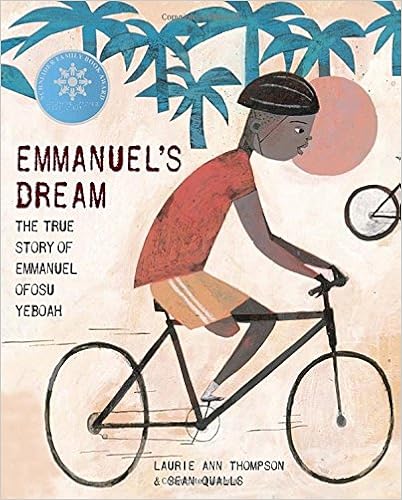
Emmanuel's Dream: The True Story of Emmanuel Ofosu Yeboah by Laurie Ann Thompson
Accelerated Reading Level: 4.4
Emmanuel was born with a deformed leg and rejected and ridiculed by many in his country of Ghana. If he wanted to go to school, he would have to hop the 2 miles each way. He also learned to play soccer on crutches he made and finally ride a bike. Emmanuel's mother helped him realize that despite his disability he could do whatever he dreamed of. After his mother's death, Emmanuel biked across Ghana to raise funds and change laws for the disabled in in country.
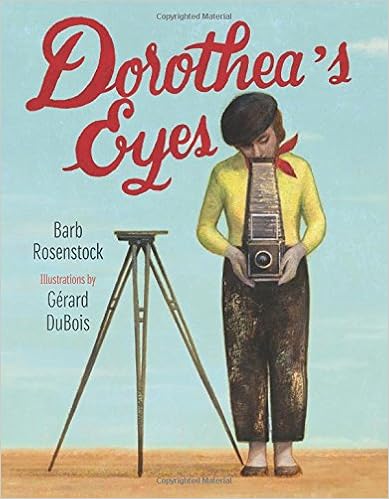
Dorothea's Eyes by Barb Rosenstock
Accelerated Reading Level: 3.3
In this book you meet the observant Dorothea Lange who had a limp caused by polio. Others are cruel and tease her because of the limp, so she develops a coping mechanism of trying to be invisible all the while intently watching those around her and focusing on their faces. In the early 1900's, Dorothea decides to become a photographer, an unheard of career for females. Dorothea decides to make it a point to take pictures of others that the world may not notice --- the homeless, the migrant workers, the disabled. Many of these stunning and memorable pictures were taken during the Great Depression. Her work inspired others including John Steinbeck's "Grapes of Wrath."
Poet: The Remarkable Story of George Moses Horton by Don Tate
Accelerated Reading Level: 4.5
George was born a slave in the South. He was a boy who loved words more than anything and despite the dangers, taught himself how to read and write. If that were not remarkable enough, George would go on to become the first published slave in the North Carolina. He would compose poems while he worked in the fields. On Sundays, he would travel into town and sell fruits and vegetables to students at the University of North Carolina. Eventually, they started paying him to write romantic poetry. Eventually, his work was published in papers and he was earning enough money to pay his master for his time so he could write full-time. This made George happy, but he still dreamed of his freedom. Pre Civil War events made it impossible for George to continue writing. Many people tried to buy his freedom, but his owner would not accept their offers. Finally, with the signing of the Emancipation Proclamation, at the age of 66, George was a free man, free to continue his love of words and poetry.
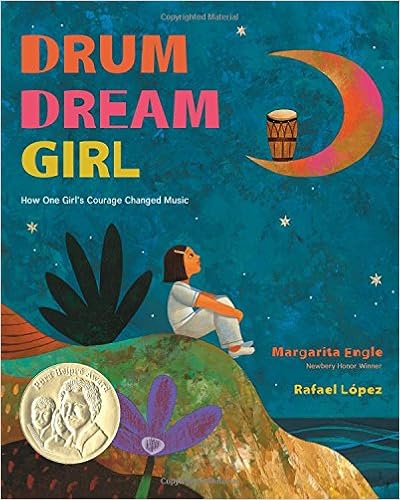
Drum Dream Girl: How One Girl's Courage Changed Music by Margarita Engle
Accelerated Reading Level: 4.2
Guided Reading Level: L
This true story of a Chinese-African-Cuban girl living in Cuba who wants to learn to drum on conga drums. This is not something girls are allowed to do in the 1930s. Despite the continual "no" from her father whenever she requested lessons, the girl finds a way to get lessons from a music teacher and then after lots of practicing she creates an all girl band. Eventually, they go on to be famous. I liked this book, but wished that the author had included the musician's name, Millo Castro Zaldarriaga, before the after note at the end of the book. This book might pair well with a writing assignment where students explain what they are passionate about and how they are working to improve their skills.
Poet: The Remarkable Story of George Moses Horton by Don Tate
Accelerated Reading Level: 4.5
George was born a slave in the South. He was a boy who loved words more than anything and despite the dangers, taught himself how to read and write. If that were not remarkable enough, George would go on to become the first published slave in the North Carolina. He would compose poems while he worked in the fields. On Sundays, he would travel into town and sell fruits and vegetables to students at the University of North Carolina. Eventually, they started paying him to write romantic poetry. Eventually, his work was published in papers and he was earning enough money to pay his master for his time so he could write full-time. This made George happy, but he still dreamed of his freedom. Pre Civil War events made it impossible for George to continue writing. Many people tried to buy his freedom, but his owner would not accept their offers. Finally, with the signing of the Emancipation Proclamation, at the age of 66, George was a free man, free to continue his love of words and poetry.
Drum Dream Girl: How One Girl's Courage Changed Music by Margarita Engle
Accelerated Reading Level: 4.2
Guided Reading Level: L
This true story of a Chinese-African-Cuban girl living in Cuba who wants to learn to drum on conga drums. This is not something girls are allowed to do in the 1930s. Despite the continual "no" from her father whenever she requested lessons, the girl finds a way to get lessons from a music teacher and then after lots of practicing she creates an all girl band. Eventually, they go on to be famous. I liked this book, but wished that the author had included the musician's name, Millo Castro Zaldarriaga, before the after note at the end of the book. This book might pair well with a writing assignment where students explain what they are passionate about and how they are working to improve their skills.
Subscribe to:
Posts (Atom)